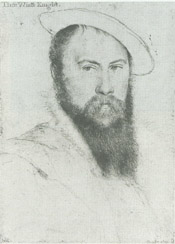
Sir Thomas Wyatt is credited with
making the sonnet popular in England. He is also famous for his feelings for Anne
Boleyn, described in the following poem, which refers to Anne as the
deer, and Henry VIII as "Caesar."
"Whoso
List To Hunt"
by
Sir Thomas
Wyatt
Whoso list to hunt, I know where is an hind,
But as for me, h�las, I may no more.
The vain travail hath wearied me so sore,
I am of them that farthest cometh behind.
Yet may I by no means my wearied mind
Draw from the deer, but as she fleeth afore
Fainting I follow. I leave off therefore,
Sithens in a net I seek to hold the wind.
Who list her hunt, I put him out of doubt,
As well as I may spend his time in vain.
And graven with diamonds in letters plain
There is written, her fair neck round about: Noli me tangere, for Caesar's I am,
And wild for to hold, though I seem tame.
Whoso list:
whoever wishes
hind:
female
deer
h�las:
alas
vain travail:
futile labor
deer:
playing on the word "dear"
Sithens:
since
Noli me tangere
:
"touch me not"
Sir Thomas Wyatt
The following message, posted by David Florkow on a university
message board, pretty much encapsulates everything I've found on the subject
of "Whoso List to Hunt":
"Sir Thomas Wyatt (1503 - 1542) is known, if
at all nowadays, for introducing the Italian sonnet form (as used by Petrarch
particularly) into English usage. Many of his best poems (such as "Whoso
list to hunt") are imitations of Petrarch (in this case, most likely
Petrarch's 190th sonnet).
"He was a diplomat in the service of Henry VIII,
traveling to Italy, France and Spain. Wyatt was imprisoned for his affair with
Anne Boleyn, and imprisoned a second time for treason after the
fall of Cromwell.
"I like this poem for the way Wyatt expresses
personal disappointment and weariness in the great chase, while still admiring a
quarry that has both eluded him and is now possessed by a greater man (Caesar).
All in sonnet form. The poet tells of his weariness in hunting a female deer
(hind). He asserts that he is not giving up, just falling further behind; his
wearied mind is still game. But as she continues to flee, he finally leaves off,
recognizing his hunt to be as fruitless as seeking to catch the wind in a net.
And he counsels others similarly inclined that they would be spending their time
in vain.
Of course, there is more than hunting deer going
on here, and the imagery and the vocabulary take a turn for the more personal in
the last four lines. For this fleeing female wears around her fair neck a necklace with diamonds spelling out
the last couplet of the poem: a phrase from the Vulgate: 'touch me not', for I
belong to Caesar (or Henry VIII, as the case may be).
"The wonderful final line captures both the
passion and the yoked submission suggested by the diamond necklace, both of
great interest to the speaker, who can appreciate both but enjoy neither.
David."
Note from Nell Gavin:
The
word "fleeth" (meaning "to flee"), used in the sonnet, suggests Anne did not entirely welcome Wyatt's
attentions, and some of her contemporaries confirmed it. This is important
because Anne Boleyn was found guilty of adultery and executed for it. Thomas
Wyatt was one of the men she was accused of having been with, and history has
speculated on this ever since. In either event, no one was able to provide substantiated proof that
Anne Boleyn ever committed adultery or had a pre-marital affair with Thomas Wyatt, or
with anyone else. That one word in this poem might validate her claims of
innocence.